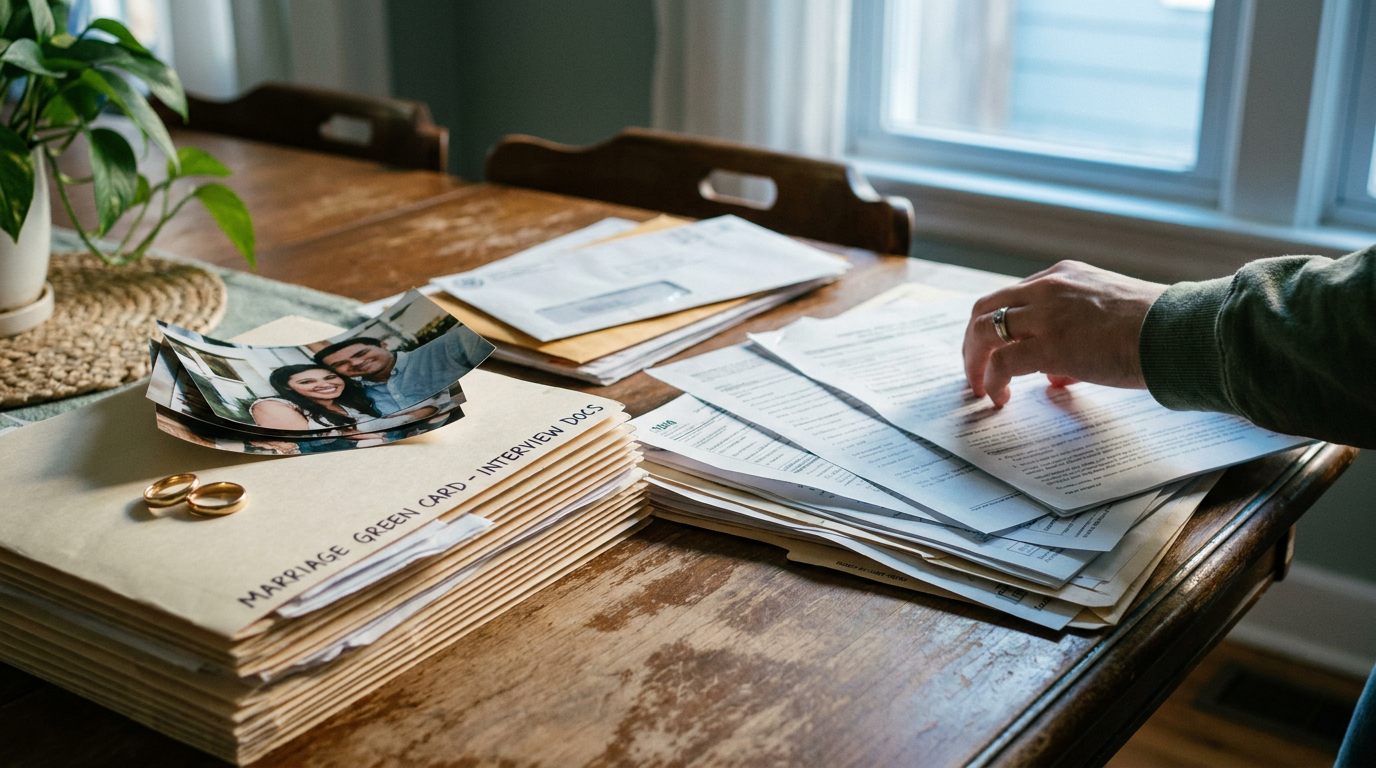
What the marriage-based green card interview is
After USCIS receives a marriage-based I-130 petition and concurrent I-485 adjustment application (or a stand-alone I-485 if the I-130 is approved separately), the case is forwarded to the local field office for an interview. The interview confirms two things: that the marriage is bona fide, and that the foreign spouse is admissible to the United States under INA § 245 (8 U.S.C. § 1255).
The interview is typically 20 to 30 minutes long, conducted jointly with both spouses present, before a single USCIS officer. It is the last major step before approval. A well-prepared couple walks out with an oral approval or a "decision will follow" notice that results in the green card arriving within a few weeks.
Documents to bring — originals
USCIS requires originals of everything you submitted as photocopies in the I-130 and I-485. Bring:
- Passports for both spouses (foreign passport for the immigrant, U.S. passport or other ID for the petitioner).
- Original birth certificates for both spouses, with certified translations.
- Original marriage certificate, with certified translation.
- Divorce decrees and death certificates for any prior marriages.
- Form I-94 for the foreign spouse.
- Form I-693 medical exam if not previously submitted (still in the sealed envelope from the civil surgeon).
- Form I-864 affidavit of support originals, with all supporting tax transcripts and pay stubs.
- Photo ID for any joint sponsor present (or a notarized signature of the joint sponsor if not present).
- Updated bona-fide-marriage evidence through the interview date — joint lease/deed renewal, recent joint bank statements, joint utility bills, recent photos, recent tax returns.
How to organize the evidence binder
We recommend a single three-ring binder with tabbed sections matching the I-130 evidence categories:
- Marriage and identity documents.
- Joint financial evidence (bank, tax, insurance, mortgage/lease).
- Joint household evidence (utilities, photos of the home, mail showing both names).
- Photographs (chronological, dated, captioned).
- Travel and life events.
- Affidavits from family and friends.
- Children of the marriage (birth certificates, school enrollment, custody documents).
- Updates since filing.
A tabbed binder lets the officer pull what they need without flipping through hundreds of loose pages.
What to expect from the officer's questions
USCIS officers vary in style — some are warm and casual, others businesslike. Common question categories:
Relationship history: How did you meet? Who introduced you? Where was your first date? When did you decide to marry?
The wedding: Where did you get married? Who attended? Who officiated? Did you have a reception? Who paid?
Daily life: What time does your spouse wake up? What does each of you do in the morning? Who cooks? Who handles the bills? What did you do last weekend?
Family and friends: What are your in-laws' names? When did you meet them? When was the last family gathering?
Finances: Do you have joint accounts? Who handles the household budget? Who paid for the wedding rings?
Plans: Do you want children? Where do you plan to live in five years?
The officer is not testing your memory of trivia. The officer is testing whether your answers match each other and whether they are consistent with the documentary evidence already in the file.
How to handle hard moments
- If you do not remember, say so. "I don't remember the exact date but I think it was around our anniversary" is fine. A confident wrong answer is worse than an honest "I don't recall."
- If your spouse misremembers, do not correct in real time. Note it for a clarification at the end.
- If the officer asks a question you don't understand, ask for clarification. Better to pause than to guess.
- If you need an interpreter, request one before the interview. USCIS provides interpreters in some offices; in others you must bring your own qualified interpreter (not the petitioning spouse).
Stokes referrals — how to avoid
If the officer suspects fraud during the joint interview, they may suspend it and refer the case for a Stokes-style separate interview. To minimize risk:
- Be early — late arrival irritates officers.
- Dress professionally (business casual).
- Answer the question asked, not the question you wish was asked.
- Bring updates that show the marriage has continued and deepened since filing — recent photos, recent joint bills, evidence of any major life events together.
After the interview
The officer will either approve on the spot, defer the decision pending a supervisor review, or issue an RFE for additional evidence. Approved adjustment applicants receive their welcome notice and the green card by mail within two to six weeks.
Conditional permanent residence (CPR) applies to a spouse who has been married less than two years at the date of adjustment. CPR requires filing Form I-751 jointly with the U.S. spouse 90 days before the second anniversary of the green card grant to remove conditions.
Common pitfalls
- Showing up without the binder. Officers expect organized evidence.
- Letting one spouse do all the talking. Both spouses must answer.
- Inconsistent stories on small details. Talk through the relationship together the night before the interview.
- Bringing the joint sponsor only in name. If the joint sponsor is required, the sponsor's documents must be original and complete.
- Forgetting the medical. If you did not submit I-693 with the I-485, bring the sealed envelope.
What to do this week
Confirm your interview date, time, and location on USCIS Online. Pull every original document. Build your binder. Practice answering basic questions out loud, as a couple. Plan to arrive 30 minutes early.
Mendoza Immigration attorneys attend marriage interviews with our clients, prepare the evidence binder, and coach the couple in a mock interview before the appointment. This article is general information, not legal advice, and reading it does not create an attorney-client relationship.
How a discretionary record protects your case <!-- pm-602-0199 -->
Adjustment of status has always been discretionary under INA § 245(a) — the May 21, 2026 USCIS memo (PM-602-0199) simply restates that. For a bona-fide marriage case, the wedding-and-life record we file is itself the Mendez-Moralez equities packet: family ties, joint financial life, hardship to the U.S.-citizen spouse if the case is denied, character references, tax compliance, and (where any adverse factor exists) the paired cure — an I-601 waiver where the statute allows, joint sponsors on the I-864, rehabilitation evidence, post-conviction relief. For the calm, plain-English read on what the memo actually says and who is unaffected, see the PM-602-0199 explainer. The short version: nothing legally changed, and a well-prepared marriage file continues to win.
References
Legal Citations
- §INA § 245 — Adjustment of status
- §INA § 216 — Conditional permanent residence
- §Adjustment regulations
- §USCIS Policy Manual — Adjustment of Status
- §USCIS Policy Manual — Family-Based Petitions
- §USCIS PM-602-0199 — Adjustment of Status is a Matter of Discretion and Administrative Grace (May 21, 2026)
Related Articles
USCIS Memo PM-602-0199, Explained Calmly: Why Adjustment of Status Has Always Been Discretionary — and What That Means for Your Case
On May 21, 2026, USCIS reaffirmed that adjustment of status is a discretionary, totality-of-circumstances decision. Nothing legally changed. Here is what the memo actually says, who is unaffected, and how a well-prepared record continues to win these cases.
Is the K-1 fiancé visa faster than marrying abroad and filing I-130?
K-1 generally puts the foreign fiancé on U.S. soil in 8–12 months versus 12–18 for an I-130/CR-1 spousal visa, but K-1 requires a second filing (adjustment of status) and typically costs more in government filing fees by the time the green card issues.
What is the I-601A provisional unlawful-presence waiver and who qualifies?
It is a waiver of the 3- or 10-year bar that lets the applicant get USCIS approval before leaving the U.S. for the consular interview — eligibility turns on extreme hardship to a qualifying U.S. citizen or LPR relative.
How long is the wait for an F4 sibling petition in 2026?
Roughly 14–17 years for most countries, 22–24 years for Mexico, and 24+ years for the Philippines — so the petition is worth filing immediately even though the green card is more than a decade away.
Will a single marijuana conviction block my green card?
Yes — a single conviction for any controlled-substance offense, including simple marijuana possession, makes the applicant inadmissible under INA § 212(a)(2)(A)(i)(II), and only a narrow 30-grams-or-less waiver under INA § 212(h) is available.