MS-13 — '503' Country Code
Salvadoran heritage marker that becomes MS-13-suggestive only when paired with other gang indicators.
Educational only — not legal advice. Images are stylized reference illustrations, not photographs of identifiable individuals. Tattoo meanings depend on context, location, personal history, and consular discretion under 9 FAM 302.5 and the USCIS Policy Manual. A single tattoo rarely determines an immigration outcome — but USCIS officers, consular officers, and ICE agents may treat certain markings as evidence of gang affiliation, including during adjustment of status interviews, naturalization interviews, asylum interviews, and credible-fear and reasonable-fear screenings. If you have any of these tattoos and face a USCIS interview, visa interview, removal proceedings, or detention, contact a licensed immigration attorney before any government interaction.
What this symbol depicts
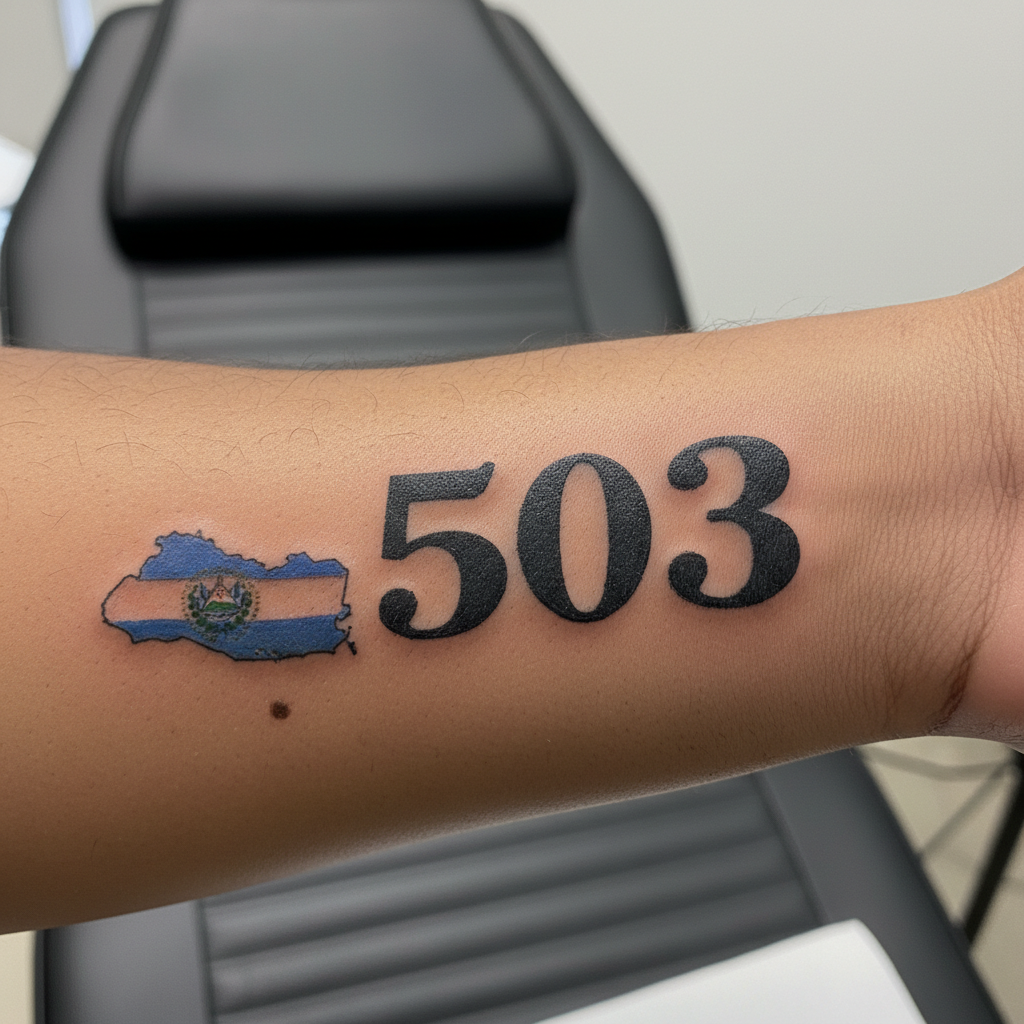
The numerals '503' (El Salvador's international dialing code), often in bold lettering, sometimes paired with a Salvadoran flag or map outline.
What officers may infer
When paired with other MS-13 indicators, '503' is treated as an MS-13-affiliated marker. Standing alone, officers typically read it as a Salvadoran national-pride tattoo.
Mitigating context
'503' is worn by huge numbers of Salvadorans in the diaspora as a pride / heritage marker — comparable to a U.S. expat tattooing the U.S. flag or a Mexican-American tattooing '52' or 'México'. Standing alone it is heritage, not affiliation.
Where it's seen
Background
The numerals '503' (El Salvador's international dialing code), often in bold lettering, sometimes paired with a Salvadoran flag or map outline. Federal enforcement guidance treats this imagery as an indicator of affiliation with MS-13 (Mara Salvatrucha). Whether that inference is correct depends entirely on context — placement, the wearer's history, the surrounding ink, and what the wearer can document about when and why the tattoo was acquired.
How U.S. officers typically read this tattoo
When paired with other MS-13 indicators, '503' is treated as an MS-13-affiliated marker. Standing alone, officers typically read it as a Salvadoran national-pride tattoo.
Why context still matters
'503' is worn by huge numbers of Salvadorans in the diaspora as a pride / heritage marker — comparable to a U.S. expat tattooing the U.S. flag or a Mexican-American tattooing '52' or 'México'. Standing alone it is heritage, not affiliation.
Why a denial based on a tattoo is so hard to challenge
In Department of State v. Muñoz, 601 U.S. 751 (2024), the Supreme Court reaffirmed the doctrine of consular non-reviewability: when a consular officer denies a visa under 9 FAM 302.5 — including a denial driven by how the officer reads a tattoo — the decision is largely unreviewable in U.S. court, even when a U.S.-citizen spouse is affected. That is precisely why getting the documentation in front of the officer before the interview matters more than challenging a denial after.
What documentation typically helps
- Photographs of the tattoo with metadata or social-media posts predating any alleged gang involvement
- Receipts, invoices, or a sworn statement from the tattoo artist
- Sworn declarations from family, employers, teachers, or clergy describing context
- Country-conditions evidence or expert testimony about the cultural, religious, or musical reference
- Records of any cover-up or laser-removal procedures
- Criminal-record checks (or absence thereof) from every country of residence
Before any interview, port-of-entry encounter, or ICE contact
Speak with an experienced immigration attorney before the encounter, not after. Once a consular officer enters a 9 FAM 302.5 denial or DHS records a gang-affiliation finding, the procedural posture is dramatically harder. Bring documentation in hand; do not rely on being able to "explain it later."
Frequently asked
Will having this tattoo automatically deny my visa or trigger removal?
No. Under 9 FAM 302.5, consular officers consider tattoos as one factor among many. Removability under INA §237(a)(2)(F) requires evidence of actual gang activity, not appearance alone. However, the burden of explanation falls on you — and after Department of State v. Muñoz, 601 U.S. 751 (2024), a consular denial is largely unreviewable in court.
Should I cover or remove the tattoo before my interview?
Concealment can backfire if discovered. Most practitioners advise documenting the tattoo's origin (year, location, artist receipt, photos pre-dating any alleged gang involvement) and being prepared to explain it directly. Consult an experienced immigration attorney before any decision to alter or remove the tattoo.
What evidence helps rebut a gang-affiliation finding?
Sworn statements from family, employers, and teachers; school transcripts and employment records; dated photographs and social-media posts; the tattoo artist's records; clergy letters where religious meaning is involved; and country-conditions reports about cultural or religious meaning. The earlier you collect this, the stronger your case.
If the consular officer denies my visa because of the tattoo, can I appeal?
Almost certainly not in court. In Department of State v. Muñoz, 601 U.S. 751 (2024), the Supreme Court reaffirmed that consular visa denials are largely unreviewable, even when a U.S. citizen spouse is affected. Preparation before the interview is far more valuable than challenging a denial after.